

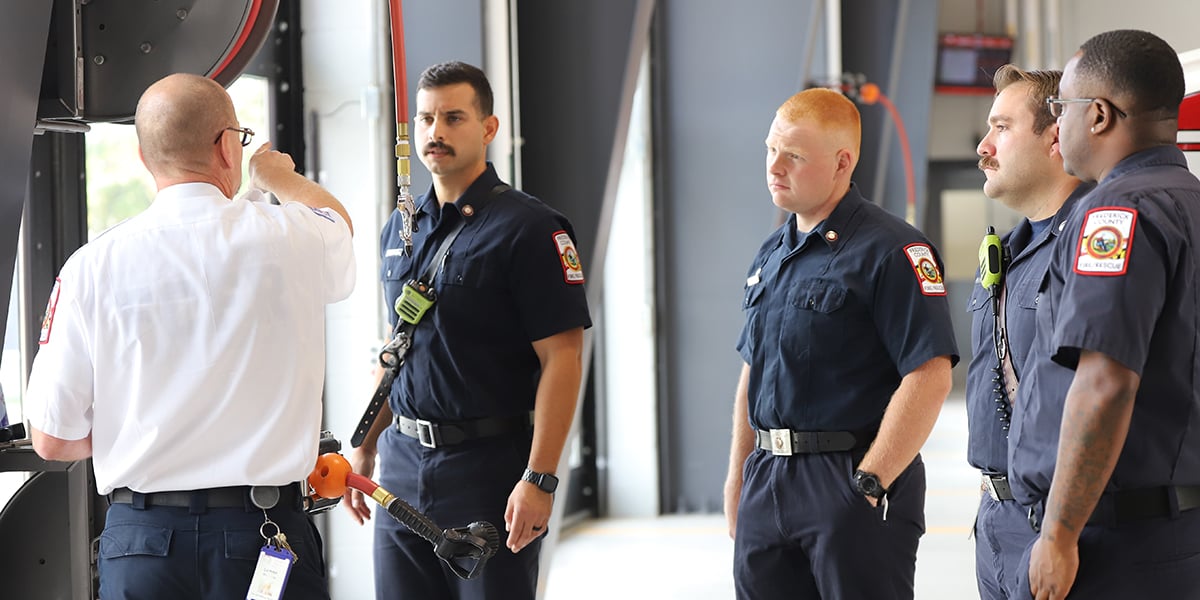
5 Tips to help you improve your leadership skills and better serve your team.
A wave of retirements and aging first responders has hit the emergency services industry—and with that comes a flood of newly-promoted managers.
While these promotions are surely exciting and well-deserved, the demand that staffing crunches are putting on many EMS agencies and fire departments can lead to you being promoted before you’re fully trained and aware of all the responsibilities that your new position entails.
For example, mid-level managers, including field supervisors and field training officers, are an integral part of maintaining a safety culture that helps ensure that everyone is functioning with safety at the center of their decision making. And, if this is news to you, that’s (unfortunately) not surprising.
While some of the risks of inexperienced supervisors may be obvious, our claims data shows that breaks in communication at the mid-level manager level could be at the center of many of the costly and inconvenient incidents that emergency service organizations are currently facing.
Mid-level managers: Please know while you’re connected to the problem, you’re not solely at fault. It’s an industry-wide issue that needs to be addressed at the organizational level—and we’re here to help. Here are a few tips to help you guide members with confidence and instill a culture of safety.
1. Ask for training.
This training should cover things like the mission of your organization, key responsibilities, and a review of key policies and procedures, including documentation responsibilities, reporting actions, and incident investigations.
If you’d like some additional insights, the VFIS’ Risk Control & Education team offers an in-person course specifically for mid-level managers, The Risk Accountability Workshop, that focuses on your role in helping reduce your organization’s risks. This class can be completed in 3 hours or less—and we’d love to present it to you and your colleagues. Reach out to your insurance broker or our team at riskcontrol@glatfelters.com to schedule!
2. Focus on communication.
As a mid-level manager, you serve as the eyes and ears of upper management—making a good flow of communication between you and your superiors vital. Let them know what’s going on and what’s happening within the team, including what policies are being followed 24/7 and which ones are falling through the cracks. And, it’s important that the flow of communication with leadership goes both ways; if you aren’t getting the feedback that you need—ask for it.
3. Avoid buddy brain.
As the eyes and ears of your organization, you’ll need to stay connected to your members, too. However, that does not mean you’re “buddies”. Going from being peers to overseeing your team can be one of the most challenging transitions for new leaders. But for the good of your department (including your friends), it’s important to help ensure everyone on your team has equal and equitable treatment.
4. Never stop learning.
Whether it’s someone in or outside of your organization, one way to continually learn and improve your leadership skills is to look for a mentor who can help you with leadership theory and purpose.
For example, what kind of leader do you want to be? What’s the meaning of being a supervisor? What qualities have you liked from previous leaders? These are questions that you may have never asked yourself—but a mentor likely would!
5. Assume the role of a leader.
There’s a lot that goes into being a leader. But some things that you can start doing today include leading by example, learning from mistakes (everyone makes them!), asking for feedback from members at all levels, delegating tasks, and looking at new ways to go about your operations to help improve efficiency and safety.
We get it. Everyone’s busy and it can seem overwhelming to add something else to your (or your boss’) to-do list. But the truth is, you deserve to be set up for success. You’ve put in the work to become a supervisor—and what you achieve directly impacts the safety of the organization and community. It’s our hope that with provisions like these, your promotion will be something you continually celebrate and honor. We believe in you!

The VFIS Team
VFIS is the largest provider of insurance, education and consulting services for fire departments, ambulance and rescue squads and 911 centers in North America, having pioneered the first tailored insurance package for this industry in 1969.
Related posts

Learn about how telematics is rapidly transforming how emergency service organizations manage fleets, improve response times, and enhance overall safety.

Here’s an overview of our learning opportunities that you can utilize to help your team address risks, overcome challenges, and expand their skillsets.



Submit a Comment